Before beginning her career as a costumer, Atwood - who was born in Quincy, WA - worked as a fashion consultant in Seattle, moving to New York City, NY in 1980 to attend NYU's film school. She got her start in the business assisting production designer Patrizia von Brandenstein on the 1981 films "Ragtime" and "A Little Sex" and also worked for NBC's "Saturday Night Live" (1975- ). Additional small screen productions that featured her designs included the television movie "Out of the Darkness" (CBS, 1985) and the three-part "Tales from the Hollywood Hills" (PBS, 1987), set in the glamorous 1930s.
Atwood's debut solo design credit was for the casual, laid-back wardrobe in Michael Apted's "Firstborn" (1984). She next gained great acclaim for designing Sting's stage wardrobe, seen in the stylized tour documentary "Bring On the Night" (1985). This film marked Atwood's onscreen debut as well, featuring the designer - who had also worked on the touring ensembles for the notoriously flamboyant Elton John - in an artistic disagreement with the singer's famously difficult manager, Miles Copeland. Indeed, he charged that the sleek shapes in which she dressed the band were "boring." Interestingly, the designer worked on 1986's "Manhunter," and 1991's "The Silence of the Lambs," both based around novelist Thomas Harris' serial killer character, Dr. Hannibal Lecter.
Atwood stayed busy throughout the 1980s, costuming the casts of the features "Critical Condition," "Someone to Watch Over Me" and "The Pick-Up Artist" all in 1987 alone. The latter film gave Atwood the task of outfitting former "Brat Packer" Molly Ringwald, a job that she would reprise in the following year's Ringwald bombs, "For Keeps" and "Fresh Horses." While her work on these features was not particularly eye-catching, it displayed Atwood's skill in creating non-distracting garb for characters when the script called for it. Economic status, social behaviour and even the inner emotions of the players began subtly evincing through her suitable clothing choices. Tom Hanks' down-at-the-heels average guy in "Joe Versus the Volcano" (1990) was dressed much differently than the successful AIDS-stricken opera aficionado he played in Jonathan Demme's "Philadelphia" (1993) - although in both films, the designer had fun with outlandish wardrobe for the volcano ceremony in the former and the costume party in the latter.
Atwood had also received enviable opportunities to show her flair for period, character and wacky costumes. In 1988's "Married to the Mob," she began her association with Jonathan Demme, decking his Mafia wives out in sleazy, sequin-studded ensembles; not unlike the costumes for the drag queen (Harvey Fierstein) in "Torch Song Trilogy" (1988). In both films, Atwood was able to balance these overdone displays of finery with realism, incorporating other characters dressed in the manner of working-class realism. Atwood capably handled both the eerily futuristic such as with "The Handmaid's Tale" (1989), as well as the dusty Old West with "Wyatt Earp" (1994), but greater acclaim came with yet another association with an even more visionary director, Tim Burton. Her clothes for his eccentric take on suburbia in "Edward Scissorhands" (1990) - both with the title character's elaborate leather suit and the almost hallucinatory pastels of the supporting cast - were almost a character in and of themselves.
Atwood also recreated recent history accurately, mining the slick and somewhat sleazy mid-1970s styles for the detective drama "Rush" (1991), the neatly tailored Kennedy era for the romance "Love Field" (1992), the over-the-top glamour of 1950s Hollywood for Burton's odd but affectionate biopic "Ed Wood" (1994), and the slim pants and fitted jackets of a mod mid-'60s rock band for Tom Hanks' "That Thing You Do!" (1996). She earned her first Oscar nomination for her sweeping 1860s-era gowns in Gillian Armstrong's "Little Women" (1994). With the hoop skirts, swags and bodices of the March family, Atwood showed not only the breathtaking styles of the Civil War, but also the genteel poverty of a New England family long past its better days. Atwood teamed again with Tim Burton for the cartoon-like nightmare comedy "Mars Attacks!" (1996), bringing the director's patented swirly doodles to fruition, with the form-fitting spiral decorated gown worn by Lisa Marie's knockout Martian.
In 1997, Atwood worked as the costume designer for "Buddy," a fact-based film about a 1920s socialite with a fondness for monkeys. In this film, Atwood rose to the rather odd challenge of dressing a gorilla in a tuxedo. That same year, she swathed the cast of the futuristic drama "Gattaca" in sharply tailored dark suits to illustrate the cold, starkness of the future. The year 1998 saw her take a similar approach to the present-day thriller "Fallen," in which her efforts gave the film a captivatingly noirish 1940s feel. She utilized authentic fabrics and patterns for that year's adaptation of Toni Morrison's novel, "Beloved," a gripping 19th Century-set slavery drama and the designer's fifth collaboration with director Demme. While the film did not fair well critically or box office-wise, it did bring Atwood her second Oscar nod.
In 1999, she took on the vastly different tasks of dressing the modern-day small town cast of "Mumford," as well as the players in Tim Burton's 1799-set Gothic horror fable, "Sleepy Hollow." The catalog chic of her "Mumford" wardrobe was appropriately simple, hearty and high-quality, but was wrought from basic designs with clean lines and utilitarian silhouettes. Using period paintings as a research aid and as inspiration, Atwood piled magnificent clothing onto the period actors in the latter film, dressing dapper constable Johnny Depp in a beautifully lined and fitted waistcoat, with era-appropriate hand detailing. The villagers of Sleepy Hollow, necessarily behind the height of high fashion, made do by showing their wealth and style with bountiful accoutrements. A corseted shape was emphasized with frills, lace and extravagant trimmings. Her evocative costumes for "Sleepy Hollow" earned her a richly deserved third Academy Award nomination. Knowing a good collaboration when she saw it, Atwood joined forces with Burton yet again, designing wardrobes for his 2001 remake of "Planet of the Apes" and 2004's fantasy "Big Fish," dressing all manner of creatures - from ape-men to gentle giants.
Her next lucrative partnership was with director Rob Marshall. Atwood's 1920s flapper-style designs for his big screen version of the stage musical "Chicago" (2002) earned her a BAFTA nomination, as well as her first Oscar win for Best Costume Design. The fruitful partnership with Marshall continued when he chose her to create the visually stunning Asian kimono styles of his next film, "Memoirs of a Geisha" (2005). Surprising no one, Atwood once again won the Oscar for Best Costume Design at the 78th Annual Academy Awards. In a bit of an departure from the period pieces, Atwood won her first Emmy for decking out dapper Tony Bennett and guests on "Tony Bennett: An American Classic" (NBC, 2006) and remained firmly in the present-day to design costumes for the perennial Tom Cruise summer blockbuster, "Mission Impossible III" (2006).
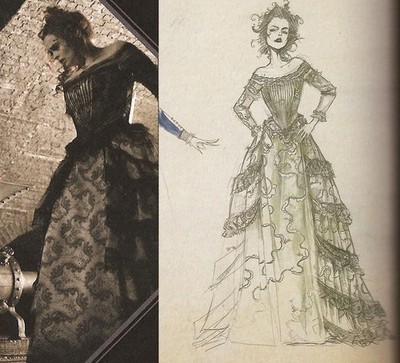
In 2007, she again returned to the lush, dramatic folds of history, earning her seventh Academy Award nomination for memorably outfitting everyone from urchins to noblemen on Olde London's rough and tumble streets in Tim Burton's version of the Stephen Sondheim musical, "Sweeney Todd: The Demon Barber of Fleet Street" (2007). Traveling back to the 1930s, she gave both Johnny Depp and Christian Bale a distinct look for their roles in 2Public Enemies" (2009), director Michael Mann's compelling look at the life and career of notorious bank robber John Dillinger (Depp). Turning back to the musical, Atwood designed the flashy costumes for Rob Marshall's "Nine" (2009), which earned her several award nominations for Best Costume Design, including a nod at the Academy Awards. Following her work on "The Tourist" (2010), Atwood found herself in Oscar contention once again for her elaborate costumes in 2Alice in Wonderland" (2010), Tim Burton's 3-D version of Lewis Carroll's classic fantasy which earned her another nod for Best Costume Design. Atwood went on to land her third Oscar for her work on the Burton film.
This biography is a very interesting biography and I didn't realise how much she had done. Below is a paragraph from the biography and I thought it is interesting how she took inspiration from old paintings. I need to think about this when designing.
'dressing the modern-day small town cast of "Mumford," as well as the players in Tim Burton's 1799-set Gothic horror fable, "Sleepy Hollow." The catalog chic of her "Mumford" wardrobe was appropriately simple, hearty and high-quality, but was wrought from basic designs with clean lines and utilitarian silhouettes. Using period paintings as a research aid and as inspiration, Atwood piled magnificent clothing onto the period actors in the latter film, dressing dapper constable Johnny Depp in a beautifully lined and fitted waistcoat, with era-appropriate hand detailing. The villagers of Sleepy Hollow, necessarily behind the height of high fashion, made do by showing their wealth and style with bountiful accoutrements. A corseted shape was emphasized with frills, lace and extravagant trimmings. Her evocative costumes for "Sleepy Hollow" earned her a richly deserved third Academy Award nomination'